DuckDB Tutorials, Benchmarks & Production Guides
DuckDB tutorials · Performance benchmarks · Production deployment guides
Code-first articles with runnable SQL and measured results
🔍 What is Olap Studio?
Olap Studio is a technical blog focused on DuckDB — the embedded columnar database designed for Online Analytical Processing (OLAP). We provide hands-on tutorials covering data analysis, ETL pipelines, and performance benchmarks. Every example is runnable, and every performance claim comes with its test conditions.
DuckDB is 3-10x faster than Pandas for large datasets, offers 10x the analytical power of SQLite, and doesn't require complex cluster infrastructure like Snowflake. Whether you're processing multi-GB CSV files or building data pipelines, DuckDB makes you dramatically more productive.
📘
Tutorials
Learn DuckDB from scratch — data analysis, ETL, big data processing with real-world scenarios
⚡
Benchmarks
DuckDB vs Pandas/Polars/SQLite — data-driven comparisons to help you choose the right tool
🧩
Advanced Techniques
Window functions, JSON processing, macros and recursive CTEs — deep dives with runnable SQL
🛠️
Best Practices
Production deployment, performance tuning, common pitfalls — make DuckDB work for you
🧭 Learning Path
1
Basics
Install DuckDB and query CSV, Parquet and JSON files directly with SQL
2
Model
Joins, window functions, CTEs and aggregations on multi-GB datasets
3
Optimize
Read EXPLAIN plans, tune memory and threads, and benchmark against Pandas
4
Production
Ship scheduled pipelines, Parquet data lakes and embedded analytics
🔥 Featured Posts
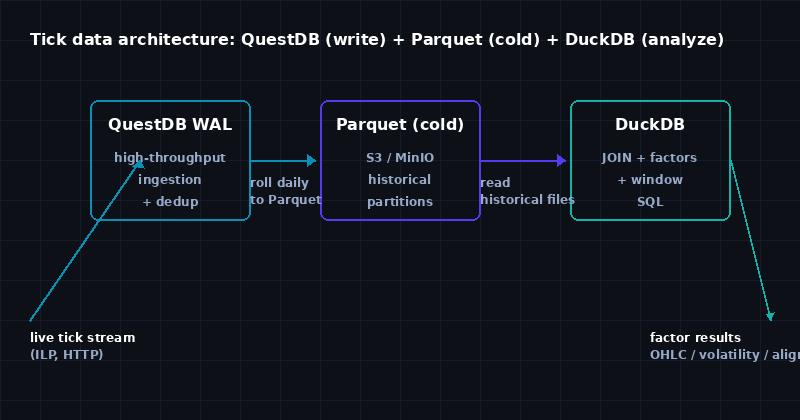
DuckDB for Tick Data Analysis: Why I Use QuestDB for Ingestion and DuckDB for Analytics
A practical tick data architecture: QuestDB handles high-throughput ingestion with WAL dedup, DuckDB handles factor computation and analysis with JOINs and window functions. Three reusable SQL patterns with test environment and results.
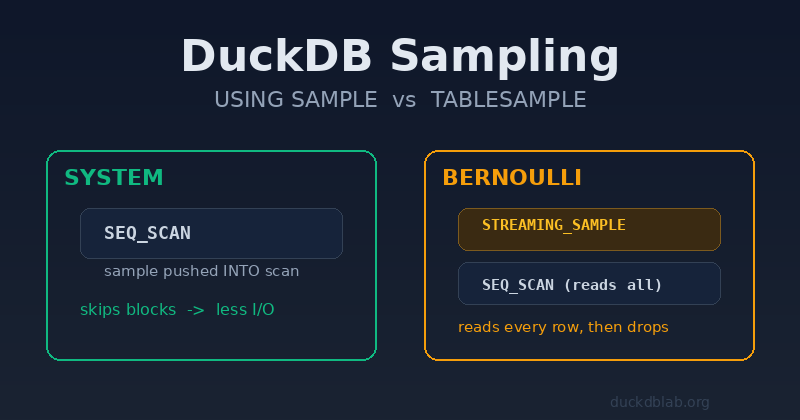
DuckDB Sampling in Depth: USING SAMPLE vs TABLESAMPLE (and When Sampling Is Slower)
A measured deep dive into DuckDB's USING SAMPLE and TABLESAMPLE: the SYSTEM, BERNOULLI and RESERVOIR methods, their hidden defaults, five syntax traps, and benchmarks showing when sampling actually beats a full scan.
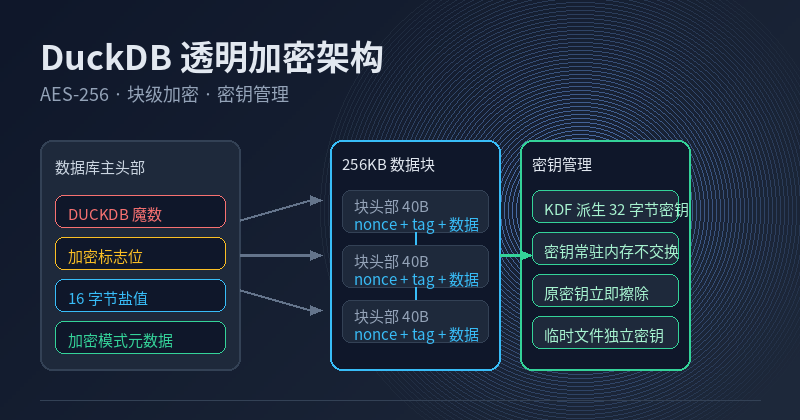
DuckDB Data-at-Rest Encryption in Practice: Block-Level AES-GCM, WAL Protection, and Key Management
Hands-on guide to DuckDB's transparent data encryption (TDE): AES-GCM-256 block encryption, encrypted WAL, KDF-based key derivation, and performance benchmarks with real numbers.
Build an Automated Financial Daily Report with DuckDB + GitHub Actions — Zero-Cost Data Product
Step-by-step guide to building an automated financial daily report system with DuckDB and GitHub Actions: data fetching, SQL aggregation, Telegram push. Zero infrastructure cost, by selling subscriptions to small investment firms
Building an Automated Investment Research Report System with DuckDB
Step-by-step guide to building a fully automated investment research report system with DuckDB — from data collection to report delivery, all in a single Python script.
DuckDB Cron-Based Data Monitoring: Rolling Mean Anomaly Detection + Auto Daily Reports, Zero-Cost Setup
Build a fully automated data monitoring system with DuckDB: rolling-mean anomaly detection, LAG day-over-day, UNPIVOT weekly reports, SKU stockout risk alerts, and cron-driven push notifications. Zero-cost service prototype for SMBs
One Person, Eight Stores: How a DuckDB-Powered E-commerce Data Service Runs on Near-Zero Marginal Cost
A proven model: one analyst serving 8 small e-commerce stores with DuckDB + cron, saving CNY 19k/month with near-zero marginal cost. Complete architecture, fixed SQL, and income breakdown
📚 Keep Going Deeper
Work through these to get DuckDB into production (install → model → optimize → deploy)
❓ DuckDB FAQ
What is DuckDB best for?
Analytical querying — data exploration, ETL pipelines, large CSV/Parquet processing, embedded BI. It's not designed for OLTP workloads (high-concurrency transactions) — that's SQLite/PostgreSQL territory.
DuckDB vs Pandas: which is faster?
On datasets over 1GB, DuckDB is typically 3-10x faster than Pandas while using less memory. DuckDB's columnar storage and vectorized execution engine give it a significant advantage for large-scale data analysis.
Does DuckDB replace a data warehouse?
For single-machine analytics up to tens or hundreds of GB, often yes — DuckDB queries Parquet and Iceberg/Delta files directly with no cluster to manage. Beyond that scale, or for high-concurrency serving, a distributed warehouse is still the better fit.
How much data can DuckDB handle?
DuckDB handles 10GB-100GB datasets comfortably on a single machine. With Parquet format and partitioning, it can efficiently process TB-scale data. For most SMB analytics needs, DuckDB is more than sufficient.